When discussing PMS vs Channel Manager, questions often arise about the role of each tool and whether it is really necessary to have both. Although they usually work together, a PMS and a Channel Manager are not the same thing and fulfil different roles within the management of tourist accommodation.
If you manage holiday apartments, holiday homes or small hotels, understanding the differences between these two solutions will help you optimise your day-to-day operations, avoid mistakes and improve your guests’ experience.
What is a PMS?
A PMS (Property Management System) is software designed to centralise and manage all operations relating to holiday accommodation from a single platform.
Its main aim is to make managers’ day-to-day work easier by automating processes and reducing manual tasks.
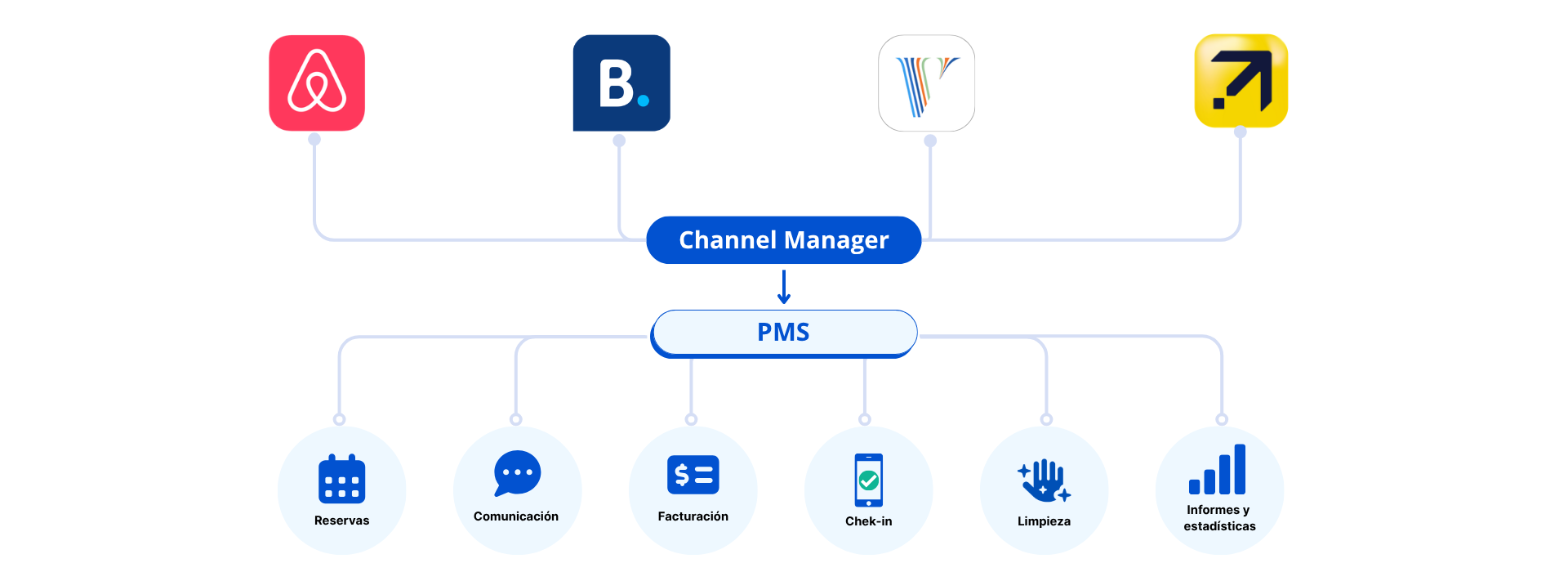
Some of the most common features of a PMS include:
- Bookings and availability.
- Calendars for all your accommodation options.
- Rates and prices.
- Communication with guests.
- Invoicing and documentation.
- Cleaning and maintenance tasks.
- Performance reports and statistics.
In other words, the PMS acts as the business’s operations centre, enabling all activity to be managed from a single location.
What is a Channel Manager?
A Channel Manager is a tool designed to synchronise availability, rates and bookings across different online sales channels.A Channel Manager is a tool designed to synchronise availability, rates and bookings across different online sales channels.
When a property is listed on platforms such as Airbnb, Booking.com or Expedia, there is a risk of receiving two bookings for the same dates if the calendars are not correctly synchronised. This is where the Channel Manager comes in.
Its main functions include:
- Automatic availability updates.
- Synchronisation of rates across websites.
- Centralised booking service.Centralised booking service.
- Inventory distribution across multiple OTAs.
- Preventing overbookings.
Thanks to this technology, whenever a booking is made on one of the connected channels, availability is automatically updated on the others.
If you would like to find out more about how these tools work, the International Holiday Rental Association provides further information on the online distribution of holiday accommodation.
Comparison table: PMS vs Channel Manager
The best way to understand the differences between the two solutions is by making a direct comparison.
| Feature | PMS | Channel Manager |
|---|---|---|
| Reservation management | ✅ | ❌ |
| Check-in and check-out | ✅ | ❌ |
| Guest communication | ✅ | ❌ |
| Invoicing | ✅ | ❌ |
| Housekeeping management | ✅ | ❌ |
| Reports and statistics | ✅ | ❌ |
| OTA synchronization | ⚠️ Can be integrated | ✅ |
| Availability updates | ❌ | ✅ |
| Rate synchronization | ❌ | ✅ |
| Overbooking prevention | ⚠️ Partial | ✅ |
As can be seen, both tools meet different yet complementary needs within the management of holiday accommodation.
PMS vs Channel Manager: key differences
Although they are often mentioned in the same breath, the fundamental difference lies in their purpose.
The PMS focuses on internal management
The PMS is designed to help you manage the day-to-day running of your accommodation.
From a single platform, you can manage bookings, operational tasks, invoicing, communications and administrative processes.
Its approach is geared towards improving the organisation and productivity of the business.
The Channel Manager focuses on distribution
By contrast, the Channel Manager has a much more specific role: to keep online sales channels synchronised.
Its role is to ensure that availability and prices are consistent across all the websites where the accommodation is advertised.
They both work together
In practice, these tools deliver better results when they are connected.
Whilst the Channel Manager distributes the information to Airbnb, Booking.com and other platforms, the PMS receives and manages all the operational tasks generated by those bookings.
Do I need a PMS or a channel manager?
The answer will depend on the number of properties you manage and how professional your business is.
They both work together
When there are only one or two properties, some tasks can be carried out manually.
However, even in these cases, automation saves time and reduces errors.
If you manage several properties
As the number of properties increases, the need for specialised tools becomes virtually essential.
Managing calendars manually across multiple platforms can lead to availability errors, wasted time and a less efficient experience for guests.
If you’re looking to scale up your business
For professional managers, holiday rental agencies and property management companies, combining a PMS with a channel manager is usually the most efficient option.
It enables you to automate processes, centralise information and maintain complete control over all operations.
Benefits of using both tools
Integration between a PMS and a channel manager offers significant benefits for any tourism business.
✅ Fewer operational errors
Automation significantly reduces errors arising from manual processes, particularly in the management of bookings and availability.
⏱️ Time saved
Many repetitive tasks are carried out automatically, allowing you to devote more time to looking after guests and growing your business.
🌍 Greater online visibility
By listing your accommodation on multiple channels, you increase your chances of receiving bookings.
💬 A better guest experience
Centralised management facilitates faster, more organised and more professional communication.
📈 Easier growth
When operations are automated, it is easier to add new properties without increasing the workload.
The ideal solution: a PMS connected to a channel manager
The current trend in the tourism sector is to opt for platforms that integrate both functionalities within a single ecosystem.
This enables managers to monitor bookings, availability, prices, communications, invoicing and operational tasks from a single interface.
As well as simplifying day-to-day work, this integration provides up-to-date information in real time and reduces reliance on manual processes.
As we have seen, comparing PMS and Channel Manager involves understanding how they complement each other to optimise the management of tourist accommodation.
Contact us and find out how we can help you simplify the management of your tourism business and grow it more efficiently.