‘What is a booking engine?’ is one of the most common questions asked by managers of holiday apartments, holiday accommodation and small hotels looking to increase their revenue without relying solely on platforms such as Booking or Airbnb.
Nowadays, being listed on the major OTAs is important for gaining visibility, but it also means paying commissions and relinquishing some control over the relationship with the guest. That is why an increasing number of tourism businesses are focusing on boosting direct bookings via their own websites.
In this context, the booking engine has become an essential tool for attracting customers, automating processes and improving the profitability of accommodation.
What is a booking engine?
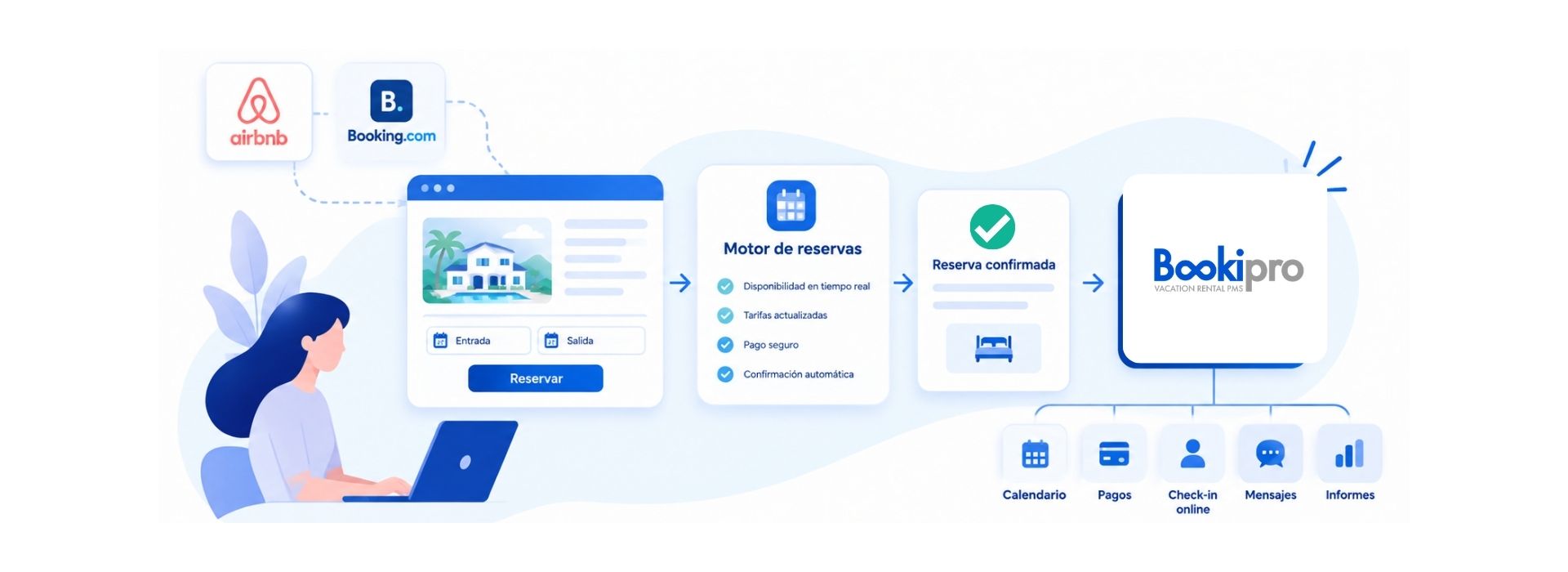
A booking engine is a tool that is integrated into an accommodation provider’s website and allows guests to check availability, select dates, make payments and confirm bookings directly, without the need for intermediaries.
In other words, it’s the system that turns visits to your website into confirmed bookings.
When a user visits an accommodation provider’s website and can book directly from it, they are using a booking engine. This technology displays real-time availability, calculates prices automatically and registers the booking instantly.
As a result, the accommodation can receive direct bookings 24 hours a day without having to process requests manually.
How does a booking engine work?
The way a booking engine works is fairly straightforward from the guest’s point of view, even though there is a great deal of automation behind the scenes.
The process usually involves the following steps:
1. The guest visits the website
Visit the accommodation’s official website via Google, social media or any other channel.
2. Check availability
Select your arrival and departure dates to see which accommodation options are available.
3. View up-to-date rates
The system automatically displays the current prices for those dates.
4. Choose your accommodation
The guest chooses the room, flat or property they wish to book.
5. Make the payment
Depending on the arrangements, you can pay for the booking in full, pay a deposit or simply secure the booking using a card.
6. Receive confirmation
The system automatically generates the booking and sends a confirmation to the customer. Furthermore, if it is integrated with the PMS and the Channel Manager, it updates availability across all connected channels.
What is a booking engine used for?
The main function of a booking engine is to increase direct bookings, but its benefits go far beyond that.
💰 Increase profitability
Every booking received directly via the website avoids some of the commissions associated with OTAs. This allows us to retain a higher profit margin per booking.
📈 Increase direct bookings
A booking engine turns the website into an active sales channel capable of attracting customers 24 hours a day.
⏱️ Save time
Automate tasks such as receiving bookings, sending confirmations and updating availability.
🎯 To have more control over the business
The accommodation provider manages the relationship with the guest directly and holds its own data for future marketing purposes.
😊 Improving the guest experience
Customers can make bookings quickly, conveniently and securely from any device.
Booking engine vs OTAs
Many managers believe that OTAs and the booking engine compete with one another, when in fact they are complementary tools.
OTAs provide visibility and help attract customers, whilst the booking engine helps to boost the direct booking channel.
“`html| Feature | Booking Engine | OTAs |
|---|---|---|
| Direct booking | ✅ | ❌ |
| Commissions | Very low | High |
| Customer control | Complete | Limited |
| Own brand | ✅ | ❌ |
| Guest data | Your own | Partial |
| Customer loyalty | High | Limited |
| Third-party dependency | Low | High |
| Offer personalization | High | Limited |
| PMS integration | ✅ | ✅ |
| Profitability | Higher | Lower |
Who should use a booking engine?
Virtually any tourism business with a website can benefit from this technology.
It is particularly useful for:
- Holiday flats.
- Holiday homes.
- Small hotels.
- Hostels.
- Aparthotels.
- Property management companies managing multiple properties.
As the number of properties under management increases, having an automated system for receiving direct bookings becomes increasingly important.
What makes a good booking engine?
Not all booking engines offer the same features.
Some key features are:
- ✔ Real-time availability.
- ✔ Integration with PMS.
- ✔ Secure payment gateway.
- ✔ Responsive design.
- ✔ Automatic confirmations
To find out more about the importance of booking engines in a direct sales strategy, you can read this explanation from the Revenue Management Society: Revenue Management Society
How does Bookipro help to increase direct bookings?
Having a booking engine is much more effective when it is integrated into a comprehensive management ecosystem.
With Bookipro, accommodation providers can centralise the management of bookings, availability and day-to-day operations from a single platform.
The integration between the PMS and the booking engine enables:
- Manage bookings from a single platform.
- Synchronise availability automatically.
- Reduce manual tasks.
- To improve the guest experience.
- Encourage direct bookings.
- To reduce dependence on OTAs.
This means that the accommodation provider can spend less time on administrative tasks and more time growing their business.
Benefits of Bookipro
- An intuitive and user-friendly platform.
- PMS and Channel Manager integrated into a single solution.
- Friendly and expert support in Spanish.
- Integrations with the main distribution channels.
- Complementary tools for digitising the guest experience.
- Settlement with guests and owners
- Price optimisation solutions to boost revenue.
Furthermore, as it forms part of a comprehensive ecosystem of tools, users can manage a large part of their business operations from a single platform, avoiding the need to use multiple providers.
Frequently Asked Questions
What is a booking engine?
It is software that enables direct bookings to be received via an accommodation provider’s website.
Can it be integrated with a PMS?
Yes. In fact, integration with a PMS is one of the most important features for automating management.
Does it help to reduce fees?
Yes. Every direct booking reduces reliance on OTAs and allows us to retain a higher profit margin.
Is it useful for holiday flats?
Yes. Holiday apartments are one of the types of accommodation that stand to benefit most from a direct booking strategy.
A booking engine enables tourist accommodation providers to attract direct bookings via their own website, reduce their reliance on OTAs and improve the profitability of their business.
Contact us and find out how Bookipro can help you streamline the management of your holiday accommodation, automate processes and keep your entire business under control, whilst you focus on growing it.