The peak season is the most profitable time of year for many holiday accommodation managers. However, it is also the time of year when the most booking-related incidents occur, with overbooking being one of the most problematic.
Although most managers already use PMS, channel managers and automated connections with OTAs, errors still occur that can lead to duplicate bookings, disputes with guests and financial losses.
In this article, we look at the seven most common mistakes that continue to cause overbooking during the peak season and how to avoid them.
What is overbooking?
Overbooking occurs when the same accommodation is booked by two or more guests for the same dates.
This can be caused by human error, synchronisation issues or management processes that are not sufficiently automated.
The consequences are often significant:
- ❌ Last-minute cancellations.
- ❌ Poor reviews.
- ❌ Penalties imposed by OTAs.
- ❌ Loss of guest confidence.
- ❌ Additional relocation costs.
That is why preventing overbooking must be a priority for any holiday manager.
Mistake 1: Managing calendars manually
Although it may seem like a thing of the past, many accommodation providers still make manual changes across different platforms.
When a booking is made via an OTA, the manager must update the other channels promptly. During the high season, when bookings come in constantly, this process becomes virtually impossible to manage.
How to avoid it
- Use a channel manager that synchronises availability in real time.
- Centralise all management within a single system.
Mistake 2: Failing to check connections with OTAs
Sometimes the problem isn’t with the PMS, but with a connection that has stopped working properly.
An OTA may lose synchronisation due to configuration changes, expired credentials or technical issues.
Platforms such as Booking, Airbnb and Vrbo regularly update their technical requirements and settings, so it is important to check that all connections remain active and are working correctly.
Warning signs
- Availability varies across platforms.
- Bookings that take a while to appear.
- Frequent synchronisation errors.
- Pending alerts in the system.
How to avoid it
- Check the condition of the connections regularly.
- Check that all bookings are received correctly in your PMS.
- Pay attention to synchronisation alerts or notifications.
Mistake 3: Accepting manual bookings without updating availability
Direct bookings remain an excellent source of revenue, but they can also pose a risk.
When a booking is received by telephone, WhatsApp, email or via the online booking form, some booking agents forget to block those dates immediately on the other channels.
A new booking for the same dates could be made in a matter of minutes.
How to avoid it
- Record all bookings in the PMS as soon as they are confirmed.
- Automate the updating of availability across all channels.
Mistake 4: Using several disconnected systems
A PMS, for one thing.
One Excel sheet for another.
Apart from Google Calendar.
And independently managed OTAs.
The more standalone tools are involved in the process, the greater the likelihood of errors occurring.
Information is no longer centralised, and even the slightest oversight can lead to inconsistencies in availability.
How to avoid it
- Centralise bookings, rates and availability on a single platform.
- Eliminates duplicate processes and unnecessary manual entries.
Mistake 5: Failing to set up stay restrictions correctly
Restrictions help to better control availability:
- – ⠀Minimum stay.
- – ⠀Maximum stay.
- – ⠀Dates confirmed on arrival.
- – ⠀Dates confirmed upon departure.
When these rules are not set up correctly, unexpected situations may arise that cause conflicts in the calendar.
Particularly during long weekends, local events or periods of high demand.
How to avoid it
- Check the restrictions before the start of each season.
- Check that the rules are applied correctly across all channels.
- Update the terms and conditions in line with demand and business strategy.
Mistake 6: Not having alerts or notifications
Many availability issues could be detected before they lead to overbooking.
However, some managers work without warning systems to alert them to:
- Synchronisation errors.
- Pending bookings.
- Changes to availability.
- Issues with channel connections.
How to avoid it
- Enable notifications relating to bookings and availability.
- Check the system notifications regularly.
- Set up alerts for potential connection or synchronisation errors.
Mistake 7: Thinking that overbooking only happens in large portfolios
There is a belief that overbooking only affects companies that manage dozens or hundreds of accommodation properties.
The reality is very different.
A single flat listed on several platforms may be overbooked if availability is not synchronised correctly.
In fact, the less automated the processes are, the greater the risk tends to be.
How to avoid it
- Automate management right from the very first booking.
- Use professional tools, even if you only manage a few properties.
- Always keep all your sales channels synchronised.
- Check regularly that availability is the same across all platforms.
A quick checklist to avoid overbookings this summer
▢⠀All my OTAs are synchronised correctly.
▢⠀Direct bookings update availability automatically.
▢⠀I manage all channels from a single platform.
▢⠀I receive alerts about potential incidents.
▢⠀I check the active connections regularly.
▢⠀I have set up the stay restrictions correctly.
Preventing overbooking does not simply depend on taking greater care. It depends on having automated processes and tools capable of keeping all the information synchronised in real time.
A PMS connected to a channel manager allows you to centralise bookings, availability and rates on a single platform, drastically reducing human error and conflicts between channels.
During the peak season, when every booking counts and any incident can affect the accommodation’s reputation, having a centralised management system is no longer just a convenience but a necessity.
Why is Bookipro the solution to preventing overbooking?
Most of the errors that lead to overbooking have a common cause: manual processes, disconnected tools or a lack of synchronisation between channels. When occupancy rises and bookings come in constantly, even the smallest glitch can become a problem for both the accommodation provider and the guest.
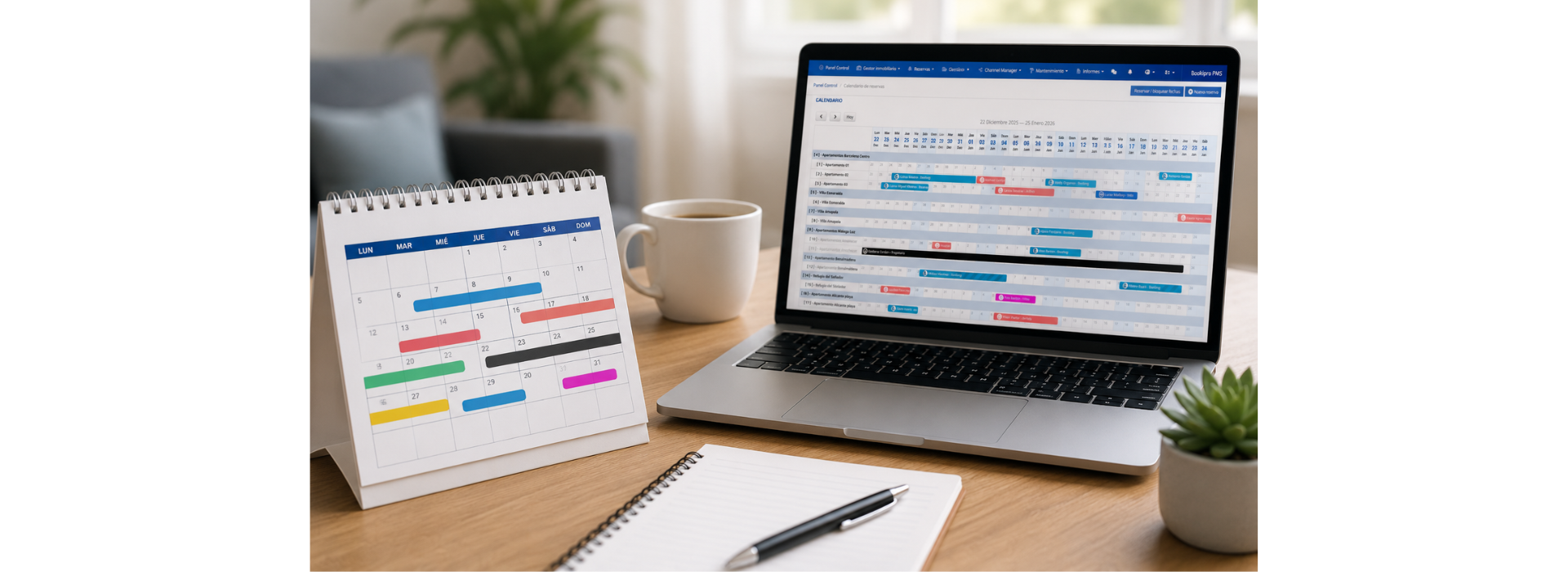
Bookipro helps to eliminate these risks through centralised management of bookings, availability and rates. From a single platform, managers can oversee all their operations and keep their calendars up to date in real time.
Furthermore, its integration with the leading OTAs and its Channel Manager ensure that any changes to availability are automatically reflected across all connected channels, significantly reducing the risk of duplicate bookings.
Thanks to process automation and a unified view of all properties, Bookipro becomes a key partner in helping you tackle the peak season with greater peace of mind, efficiency and control.
For further information, please contact us; and if you’re not yet using Bookipro, request a demo and find out how it can fit into your operations.