Catalonia ended 2025 confirming a strategic shift in its tourism model: moving from volume to value. Official data shows that growth in the sector has not been based so much on attracting more visitors, but rather on increasing spending and profitability per tourist.
More spending, less dependence on volume
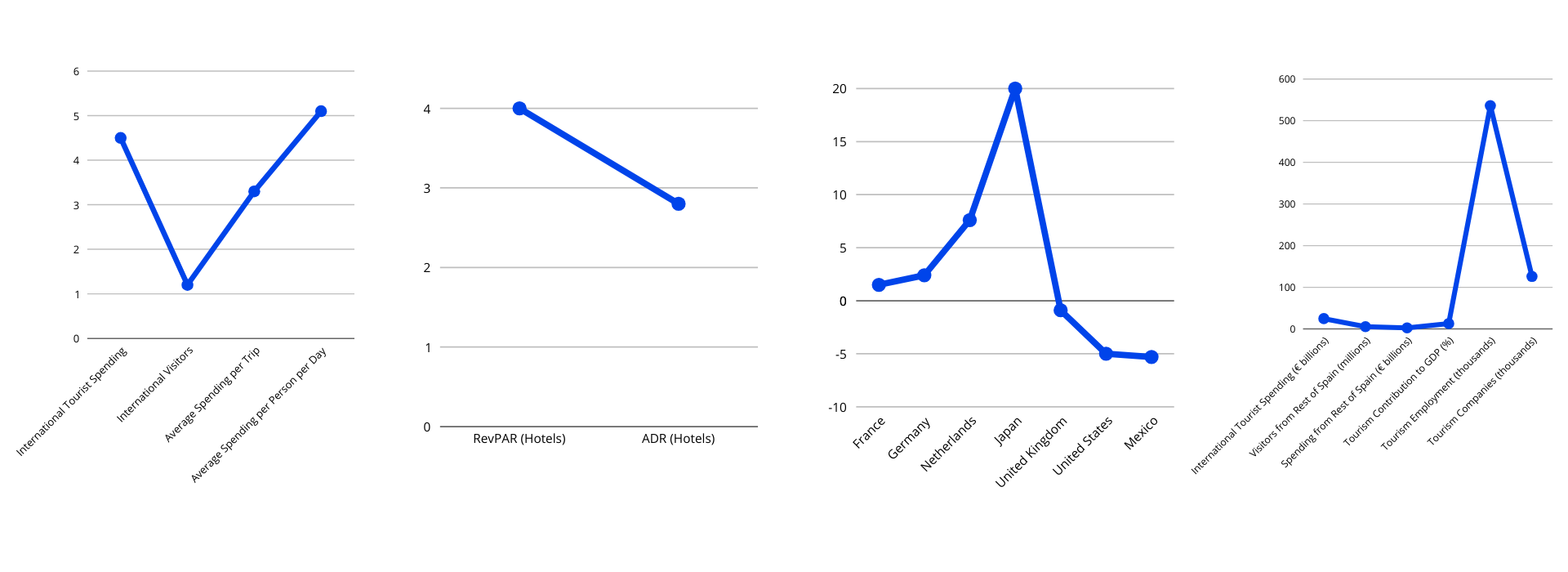
During 2025, international tourist spending grew by +4.5%, reaching €24.826 billion. In contrast, the number of international visitors only increased by +1.2%.
This difference is key: spending has grown almost four times more than the volume of tourists. Furthermore:
- The average expenditure per trip increased by +3.3%.
- Average expenditure per person per day grew by +5.1%.
This confirms that growth is due to an improvement in visitor quality and spending power, rather than a massive increase in arrivals.
Consolidated deseasonalisation
One of the most relevant indicators is the progress made in the temporal distribution of demand. In 2025:
- Two out of three tourists arrived outside the summer season.
- The period from June to August accounted for only 32% of arrivals, compared to 68% for the rest of the year.
Over the last decade, deseasonalisation has improved by 5 percentage points, reinforcing a more balanced model throughout the calendar year.
Source markets: Asian strength
By tourist origin:
- France remains the main market (+1.5%).
- Germany grew by +2.4%.
- The Netherlands stood out with +7.6%.
- Japan recorded exceptional growth of +20%.
In contrast, the United States fell by 5%, affected by the international geopolitical context. However, developments in the Asian market offset this decline.
Accommodation indicators: improved profitability
In the hotel sector, data between January and November show:
- RevPAR +4% (revenue per available room).
- ADR +2.8% (average daily rate).
These indicators reflect an improvement in the sector’s profitability.
Tourism accounts for between 12% and 14% of Catalonia’s GDP, with around 14% of total employment (536,000 people employed) and more than 126,000 companies linked to the tourism ecosystem.
Culture and sport as strategic pillars
Looking ahead to 2026, Catalonia is strengthening its international position through culture and sport. Events such as Gaudí Year, Pau Casals Year, Barcelona World Capital of Architecture and the start of the Tour de France consolidate a global strategy focused on quality tourism.
Furthermore, initiatives such as the Vivaent project, focused on senior tourism, seek to continue promoting the deseasonalisation and diversification of demand.
A more balanced model
The data for 2025 confirms a clear trend: Catalonia is moving towards a more balanced tourism model, less dependent on mass tourism and more focused on added value, territorial distribution and economic sustainability.
In a context where tourism continues to be one of the main economic drivers in the region, the challenge is no longer to grow more, but to grow better.